Subscribe
18:00Tao calls OpenAI’s Navier–Stokes push “resource extraction”17:10LAPTOP memecoin hits $190.81, then loses 99% inside an hour17:05Hubinger puts the odds of AI killing everyone above 10%; a colleague resigns16:39CancerBench launches; five frontier models tied at zero cancer types cured16:30ElevenLabs preparing 2028 IPO after $11bn round, The Information reports16:30Anthropic retracts its July explanation: Mythos 5 attacked systems knowingly
Hardware3 min read

Someone outside Google finally measured a TPU, and the interesting number is not the headline

SemiAnalysis puts Ironwood at $0.181 per million tokens against $0.222 on a B200. The comparison Google most needs to win is the one that isn't published yet.
In briefSemiAnalysis published the first third-party TPUv7 Ironwood inference results on September 7, 2026, showing up to 50% better performance per dollar against B200/B3001Ironwood costs approximately $0.181 per million total tokens at 100 tokens/s/user versus $0.222 for B200 and $0.276 for B3002At 20 tokens/s/user Ironwood reaches 9,364 tokens/s/chip and delivers 50.4% more tokens per dollar than B200 and 96.0% more than B3003
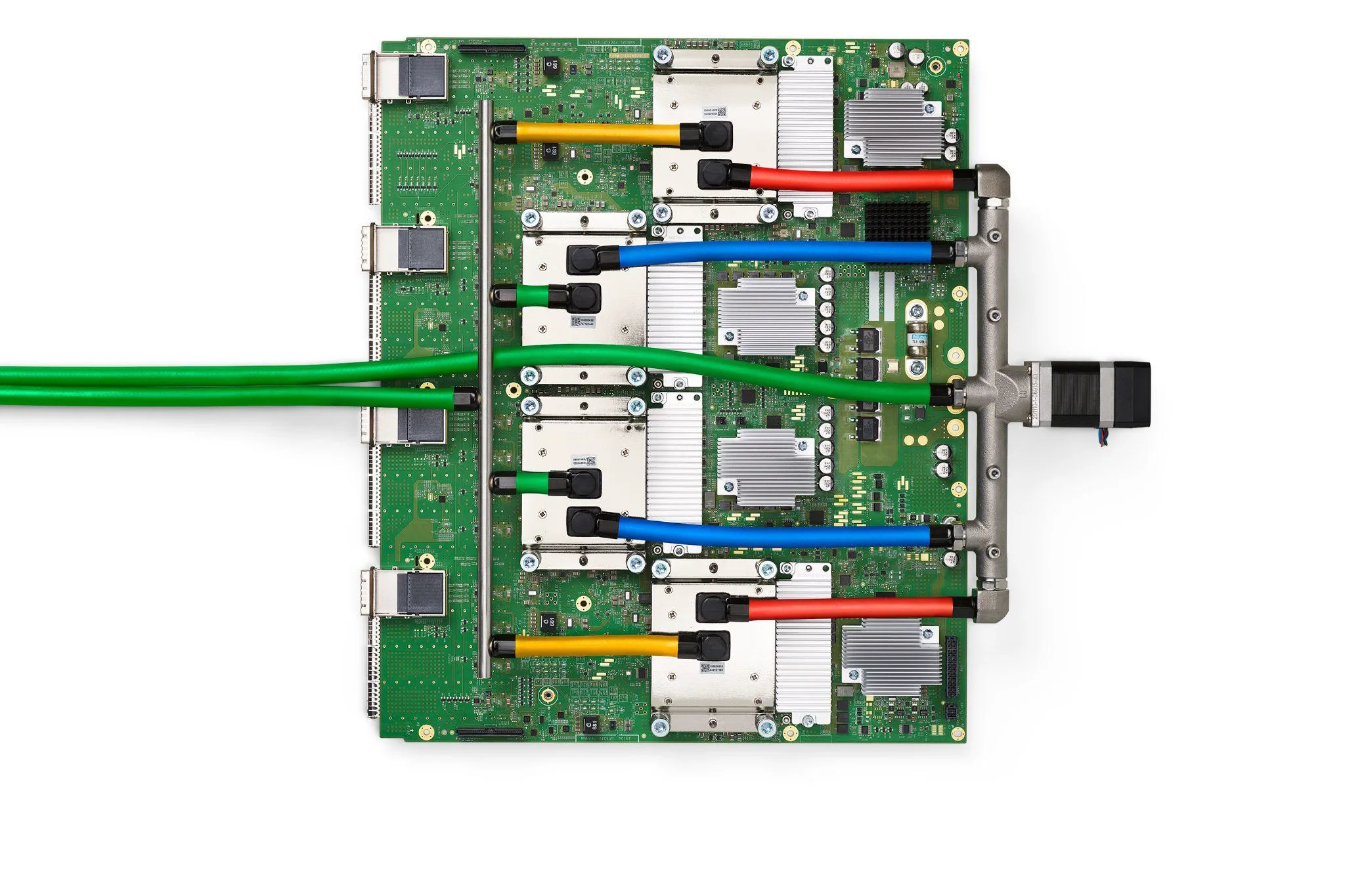
A Google TPU board with network cables attached
Photo: Norman P. Jouppi, George Kurian, Sheng L (CC BY 4.0)

SemiAnalysis published the first third-party inference numbers for Google's TPUv7 Ironwood on September 7th, and put it at $0.181 per million tokens at 100 tokens per second per user, against $0.222 on an Nvidia B200 and $0.276 on a B300. On raw throughput at 20 tokens per second per user it reached 9,364 tokens per second per chip, about 5% above either Blackwell part.

Cost per million total tokens at 100 tok/s/user ($)
TPUv7 Ironwood0.18Nvidia B2000.22Nvidia B3000.28

For more than a decade, everyone who could tell you what a TPU costs per token worked at Google. That is the story. The ratios will move.

Dylan Patel@dylan522p

We are excited to bring the first open benchmarking of Google's TPUs to the world
Running every day, on many models + scenarios
$/token is better than B200 and B300
Huge shout-out to Google @inferact and the InferenceX team at SemiAnalysis to this effort that's taken many months

on X · 191.3K views · captured Sep 10, 2026

The alert SemiAnalysis posted the next morning says "50% better perf per dollar than Blackwell Ultra." Read the article and the 50.4% figure is against the B200. Against B300 — which is Blackwell Ultra — the same run shows 96.0%. So the promotional tweet names the wrong chip and, in doing so, undersells its own result by half. We mention it because this is the number that will be repeated for a year, and somebody should say which comparison it came from.

SemiAnalysis@SemiAnalysis_

ALERT🚨🚨: On apples-to-apples InferenceX Comparisons, TPUv7 Ironwood achieves 50% better perf per dollar than Blackwell Ultra on the new TorchTPU external inference stack!

TorchTPU brings native PyTorch to TPUs, & along with Google open-sourcing a bunch of their Pallas inference kernels, Google has laid out a solid foundation for TPU to rapidly externalize. We at SemiAnalysis strongly believe that TPU externalization is heading in the right direction and moving full steam ahead.

on X · 98.4K views · captured Sep 10, 2026

Now the part that matters more. Every figure above is aggregated serving against aggregated serving, on Qwen3.5 397B in FP8, chosen as a bring-up model. Large operators run disaggregated prefill and decode. SemiAnalysis is direct about what happens there: "today, GB200/300 NVL72 is more competitive on perf per dollar in a disagg-vs-disagg comparison," and in the mixed comparison they do publish, a GB300 NVL72 running disaggregated holds roughly a 30% advantage over TPUv7 running aggregated in the middle of the latency curve.

There is a latency cost too, and it is not small.

Mean time to first token at concurrency 256 (seconds)
TPUv7 Ironwood5.41Nvidia B2003.75Nvidia B3002.4

So which chip is cheaper? It depends on where on the curve your product lives, which is the honest answer and also the reason vendor benchmarks pick a point and stop. If you serve a chat interface where the first token has to land in under three seconds, the Ironwood advantage at concurrency 256 is not available to you at all.

We would read this as a software release wearing a silicon headline. TorchTPU lets vLLM treat a TPU as a native PyTorch device instead of translating through JAX, Google has open-sourced Pallas inference kernels, and the stack is due out of private beta around October. TPUv7 has no native FP4, so Nvidia keeps the lead whenever a customer accepts FP4 quality loss, and Google's answer to that is TPUv8i, which does not exist to benchmark.

The fair objection to all of it: SemiAnalysis thanks sixteen named Google engineers and the Inferact team in the piece, Google supplied the stack under test, and the TCO figures come from SemiAnalysis's own subscription model rather than from an invoice. That is not a scandal — you cannot benchmark a chip nobody will sell you without help from the seller — but it is a long way from an independent lab.

Our expectation is that the promised TPUv7-disaggregated versus GB300 NVL72-disaggregated follow-up, whenever it lands, shows Nvidia still ahead on the middle of the Pareto curve, and that the perf-per-dollar gap in Google's favour survives only at the high-latency end. A first published disagg run where TPUv7 matches GB300 across the curve would settle it against us.

Anthropic has committed to more than a million of these chips, most of them for training. Somebody at Anthropic already knew all of this. Now the rest of us have a number to argue with.

Sources

01
SemiAnalysis published the first third-party TPUv7 Ironwood inference results on September 7, 2026, showing up to 50% better performance per dollar against B200/B300Today, we are publishing the first third-party inference results for TPUv7 Ironwood on InferenceX Official Preview. In our apples-to-apples comparisons against B200/B300, Ironwood delivers up to 50% better performance per dollar.” — newsletter.semianalysis.com · primary · Sep 10
02
Ironwood costs approximately $0.181 per million total tokens at 100 tokens/s/user versus $0.222 for B200 and $0.276 for B300At an interactivity of 100 tokens/s/user, Ironwood costs approximately $0.181 per million total tokens, compared with $0.222 for B200 and $0.276 for B300. That is approximately 19% lower cost than B200 and 34% lower than B300, while…” — newsletter.semianalysis.com · primary · Sep 10
03
At 20 tokens/s/user Ironwood reaches 9,364 tokens/s/chip and delivers 50.4% more tokens per dollar than B200 and 96.0% more than B300at interactivity of 20 tok/s/user, Ironwood also leads on raw throughput, reaching 9,364 total tokens/s/chip, compared with 8,903 on B200 and 8,925 on B300. This is approximately 5% higher throughput than either GPU in these runs.…” — newsletter.semianalysis.com · primary · Sep 10
Show all 11 sources
04
At concurrency 256 TPU mean time to first token is 5.41 seconds versus 3.75 on B200 and 2.40 on B300For example, at concurrency 256, TPU mean TTFT is 5.41 seconds, compared with 3.75 seconds on B200 and 2.40 seconds on B300. The previously discussed 50% to 96% advantage applies to this datapoint specifically, rather than every latency…” — newsletter.semianalysis.com · primary · Sep 10
05
GB200/300 NVL72 is more competitive in a disaggregated comparison, and GB300 NVL72 disagg holds about a 30% perf-per-dollar advantage over TPUv7 aggregated in the middle of the curveGoogle has been running disaggregated serving internally for years in production and that path is heavily optimized, but the external TPU serving stack does not have a fully optimized disagg path yet. So today, GB200/300 NVL72 is more…” — newsletter.semianalysis.com · primary · Sep 10
06
The benchmark uses Qwen3.5 397B in FP8 as the bring-up model and the stack is expected to leave private beta and be open sourced around OctoberGoogle is using Qwen3.5 397B in FP8 as the initial bring-up model. ... The stack is expected to leave private beta & be open sourced around October.” — newsletter.semianalysis.com · primary · Sep 10
07
TPUv7 has no native FP4 computation, so Nvidia GPUs retain the lead on FP4; TPUv8i adds native FP4When serving models using FP4 on NVIDIA GPUs, there is quality loss verus FP8. TPUv7 does not have native FP4 computation thus on FP4, NVIDIA GPUs still maintains the lead. This will change with TPUv8i which has native FP4 support” — newsletter.semianalysis.com · primary · Sep 10
08
TorchTPU lets developers use TPUs as native PyTorch devices with StableHLO, XLA and Pallas kernels underneathIt lets developers use TPUs as native PyTorch devices, while StableHLO, XLA, and TPU-optimized Pallas kernels handle the low-level execution behind the scenes.” — newsletter.semianalysis.com · primary · Sep 10
09
Anthropic has committed to over one million TPUs, around 400k direct purchases and 600k rented through GCPIn November 2025, we already said that Anthropic loves TPUs and committed to over one million of them (around 400k+ in direct purchases and 600k+ rented through GCP), used mainly for training but also for inference.” — newsletter.semianalysis.com · primary · Sep 10
10
Dylan Patel announced the benchmark on X, saying $/token is better than B200 and B300We are excited to bring the first open benchmarking of Google's TPUs to the world Running every day, on many models + scenarios $/token is better than B200 and B300 Huge shout-out to Google @inferact and the InferenceX team at…” — x.com · primary · Sep 10
11
The SemiAnalysis account described the result as 50% better perf per dollar than Blackwell UltraALERT🚨🚨: On apples-to-apples InferenceX Comparisons, TPUv7 Ironwood achieves 50% better perf per dollar than Blackwell Ultra on the new TorchTPU external inference stack!” — x.com · primary · Sep 10
Up next · Keep readingHardware · 3 min read

A20 Pro is the first 2nm phone chip. The number that matters is 32 Neural Engine cores after three years at 16

Apple doubled the Neural Engine, widened memory bandwidth 50 percent, moved the DRAM off the thermal path and tripled the vapor chamber. Every one of those decisions is about running models on the phone.

Continue ↓