Nvidia's 800-volt data centre now starts with one rack inside a building you already own
The 2025 pitch was converting grid power to 800 VDC at the perimeter. The 2026 product slots into existing AC infrastructure and changes nothing about the building.
Nvidia's 800 VDC architecture is being rolled out in three steps that run alongside existing alternating-current plant rather than replacing it, with the adoption level decided facility by facility. SemiAnalysis laid out the sequence on September 9th: a power rack that delivers 800 volts DC into the compute racks and standardises the DC interface and backup configuration; then a row-level power center handling centralised rectification and feeding a high-density row over a busway; then, eventually, a hall-level DC power block.

NVIDIA’s 800 VDC plan includes a phased rollout that operates alongside existing AC distribution systems. The adoption level depends on each facility individually, rather than replacing an entire plant all at once.
In the short term, NVIDIA’s Power Rack delivers 800V DC into the compute racks and standardizes the DC interface and backup configuration so it can fit existing AC infrastructure. Following this, a row-level Power Center manages centralized rectification and supplies a full high-density row via a busway, reducing cabling complexity in white space. Over the longer term, a hall-level DC Power Block becomes the standard power building block, supporting higher-density loads.
NVIDIA will collaborate with industry partners to expand demonstration and pilot sites ahead of large-scale deployment.

Read that against what Nvidia was saying in May 2025 and the change of register is the story. Back then the architecture was a redesign from the grid inward — 13.8 kV AC converted straight to 800 VDC at the data centre perimeter by industrial rectifiers, eliminating most intermediate conversion steps. Now the first product is a rack that, in Nvidia's own words, is "designed to slot into existing AC infrastructure and deliver 800 VDC to compute racks within the row — no changes to the building's electrical system required."
So it is a smaller claim. It is also, if you operate a building that already exists, a far better product.
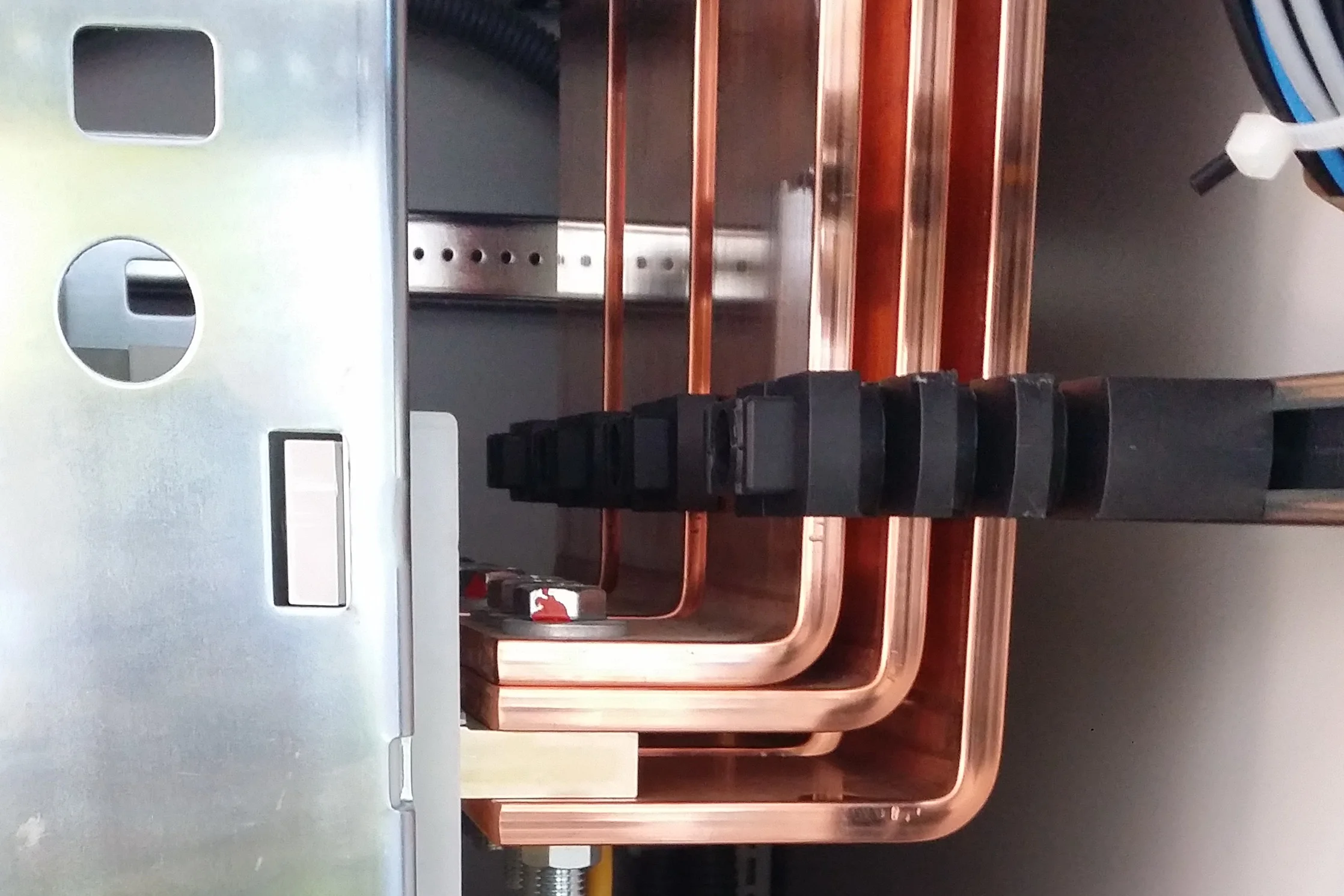
The physical argument has never been in doubt, and it is worth stating plainly because it is the reason any of this is happening. At 54 VDC, a 1 MW rack needs up to 200 kg of copper busbar. Scale that to a gigawatt campus and the rack busbars alone reach 200,000 kg of copper. And a Kyber-class rack running MW-scale power shelves at 54 V would eat up to 64 rack units (of 42-odd in a standard cabinet) before you install anything that computes.
Hold those last three loosely. The 5% efficiency, 70% maintenance and 30% TCO figures were published in 2025 against a fully native 800 VDC facility with single-step conversion at the perimeter. A power rack sitting behind an unchanged AC plant keeps every upstream conversion stage it was supposed to delete, so it captures the in-rack part of the saving and very little of the rest. Nobody has published a number for the hybrid case, and until someone does, treat the 30% as a description of a building almost nobody will operate before 2029 (which is not the same as a wrong number).
So is the retreat bad news? Probably the opposite. Electrical standards get adopted through hybrids or they do not get adopted at all, and the supporting evidence here is unusually solid: Nvidia, Google and Microsoft developed the architecture jointly through the Open Compute Project, published a white paper in March and an LVDC solid-state transformer specification in July, and more than 80 equipment makers are building to it. A specification with 80 suppliers behind it is a supply chain rather than a slide.
What we would watch is the row. The power center — 2 MW per row over an overhead busway — is the step where an operator has to change something structural, and Nvidia dates it to 2027. SemiAnalysis says Nvidia will "collaborate with industry partners to expand demonstration and pilot sites ahead of large-scale deployment," which is the language of a product that does not yet have a reference customer to name.
Our expectation is that essentially every 800 VDC deployment announced through 2027 is a power rack inside an AC building, and that the hall-scale DC power block still has no named operator by the end of 2027. A greenfield gigawatt campus announcing native 800 VDC before then would move us.
Either way, somebody is going to save 200 tonnes of copper per gigawatt, and copper is not getting cheaper.
Sources
Show all 10 sources
A20 Pro is the first 2nm phone chip. The number that matters is 32 Neural Engine cores after three years at 16
Apple doubled the Neural Engine, widened memory bandwidth 50 percent, moved the DRAM off the thermal path and tripled the vapor chamber. Every one of those decisions is about running models on the phone.
Continue ↓